
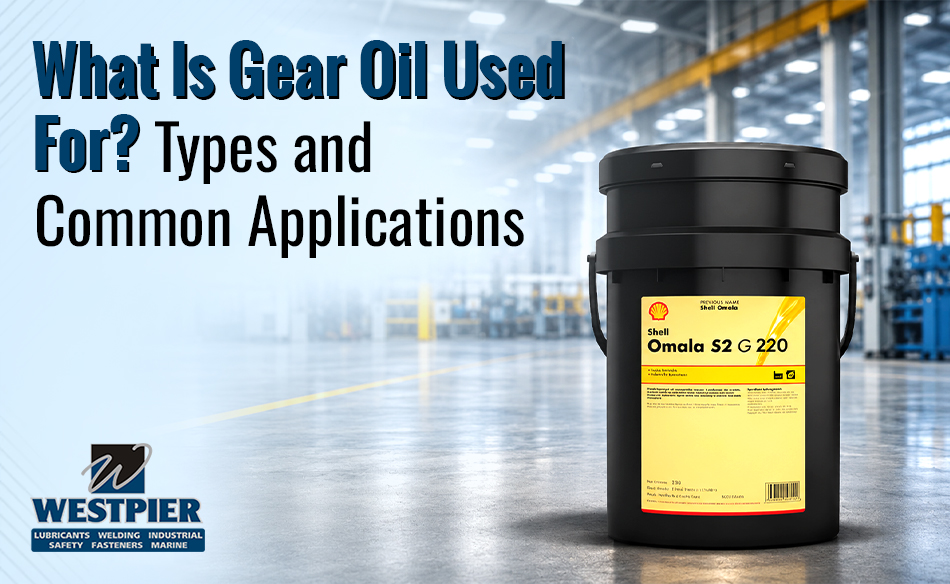
Gear oil is used to lubricate gears, reduce friction and wear, manage heat, and protect gear surfaces under load. It is commonly found in automotive differentials, manual transmissions, axles, heavy-duty drivetrains, industrial gearboxes, gear reducers, and other equipment that relies on gears to transfer power.
The right gear oil is not determined by the words “gear oil” alone. Different gear systems have different requirements for viscosity, load, temperature, gear design, and lubricant performance. At WestPier, we work with a range of industrial lubricants, so we know that choosing the right product starts with understanding the equipment and its operating conditions.
What is Gear Oil?
Gear oil is a lubricant formulated for gear systems where metal surfaces come into contact while transferring power. As gears rotate and mesh, they generate friction, heat and surface pressure. The lubricant forms a protective film between these surfaces, helping control friction and wear during operation. Gear oils can also contain additives that provide specific performance properties.
Depending on the formulation, these may include extreme-pressure (EP) additives, oxidation inhibitors, corrosion protection, and foam control. The term covers a broad range of products. An automotive differential, an industrial gearbox, and a heavy-duty axle may all use gear oil, but they do not necessarily require the same formulation. The equipment manufacturer’s specification should always guide the selection.
Common Uses of Gear Oil
Gear oil is used wherever gears need lubrication while transferring mechanical power. Applications range from passenger vehicle differentials to large industrial gearboxes that operate for long hours.
Automotive Differentials
A differential transfers power to the drive wheels while allowing them to rotate at different speeds when a vehicle turns. Many differentials use hypoid gears, which can experience substantial sliding and loading at the gear teeth. The gear oil needs to provide the performance required by that particular differential, including the specified viscosity and service classification.
Manual Transmissions and Transaxles
Manual transmissions contain gears, bearings, and other moving components that require lubrication as power passes through the transmission. The specified lubricant varies by transmission design. Some manual transmissions use gear oil, while others require a specific manual transmission fluid. A product that works in a differential should not automatically be assumed to be suitable for a manual transmission.
Heavy-Duty Axles and Drivetrains
Trucks, buses, agricultural machinery, construction equipment, and other heavy-duty machines can use gear oil in axles, final drives, and other gear assemblies. These systems may operate under high loads, shock loading, long service periods, and changing temperatures. The lubricant therefore needs to match the equipment manufacturer’s requirements rather than being selected on viscosity alone.
Industrial Gearboxes and Gear Reducers
Gear oil is widely used in enclosed industrial gearboxes and gear reducers. These systems are found in conveyors, manufacturing equipment, cranes, material-handling systems, pumps, and many other machines.
Industrial gear oils may be formulated for different gear arrangements and different operating conditions. For instance, Shell’s industrial gear oil documentation includes spur, helical, bevel, planetary, and worm gear applications, and specifications such as ISO 12925-1 and AGMA are listed for relevant products.
Marine and Specialized Equipment
Gear lubrication is also important in marine equipment, forestry machinery, mining equipment, wind turbines, and other specialized systems. The application itself does not determine the product. Gear design, load, speed, temperature, and the equipment manufacturer’s specification all have to be considered.
Main Types of Gear Oil
Gear oils can be classified in several ways. Mineral and synthetic describe the base oil, while automotive and industrial describe the application. Viscosity grades and service classifications provide another way to distinguish between products.
Mineral Gear Oil
Mineral gear oils use mineral base oils and are available in different viscosity grades and additive formulations. They are used across many automotive and industrial applications where the product meets the equipment requirements.
Synthetic Gear Oil
Synthetic gear oils use engineered base fluids and may be selected for applications involving demanding temperatures, extended service intervals, or other specific performance requirements. Whether a synthetic product is appropriate still depends on the equipment specification.
Semi-Synthetic Gear Oil
Semi-synthetic formulations combine mineral and synthetic base-oil components. They are available for applications where this type of formulation meets the equipment manufacturer’s requirements.
Automotive and Industrial Gear Oil
Automotive gear oils are commonly used in differentials, axles, and certain manual transmissions, while industrial gear oils are formulated for equipment such as enclosed gearboxes and gear reducers.
The specifications used for these products can differ considerably. For industrial applications, classifications such as ISO 12925-1 and AGMA may appear in technical documentation. That is why an automotive gear oil should not be treated as a direct substitute for an industrial gear oil simply because both are described as gear lubricants.
Understanding Gear Oil Viscosity Grades
Viscosity describes a lubricant’s resistance to flow. Automotive gear oils commonly use SAE viscosity grades such as 75W-90, 80W-90, and 85W-140. SAE J306 classifies automotive driveline lubricants by their rheological properties. In other words, the SAE grade tells you about viscosity behaviour. It does not by itself establish all the other performance characteristics required for an application.
| Gear oil grade | General description |
|---|---|
| 75W-90 | Multigrade automotive gear lubricant |
| 80W-90 | Multigrade automotive gear lubricant |
| 85W-140 | Higher-viscosity multigrade gear lubricant |
The “W” designation indicates the lubricant’s winter or low-temperature viscosity grade, while the second number identifies its high-temperature viscosity grade. A higher number is not automatically a better choice. The correct viscosity depends on the equipment design, operating temperature, load, and manufacturer’s recommendation.
What Do API GL-4 and GL-5 Mean?
API GL-4 and GL-5 are service designations used for automotive gear lubricants. API Publication 1560 describes these designations and their application to manual transmissions, transaxles, and axles. They should not be treated as a simple ranking in which GL-5 is always better than GL-4.
Different equipment can call for different service categories, and the required lubricant also needs to be suitable for the materials and components inside the transmission or axle. For that reason, check the manufacturer’s specification before switching between GL-4 and GL-5 products. The correct classification is the one specified for the equipment, not necessarily the one with the higher number.
How Do You Choose the Right Gear Oil?
Start with the equipment manufacturer’s requirements. The label on a container may tell you the viscosity and service classification, but those details only have meaning when they match the application.
- Check the Required Viscosity: Look for the specified SAE or ISO viscosity grade. Do not switch to a thicker or thinner product simply because it is available or appears to offer more protection.
- Confirm the Performance Specification: Check whether the equipment requires an API, AGMA, ISO, or another performance classification. Two gear oils with the same viscosity can still have different additive systems and performance characteristics.
- Consider the Operating Conditions: Temperature, load, speed, shock loading, operating hours, and contamination can all affect lubricant requirements. Industrial gearboxes may also face water exposure or other conditions that need to be considered during product selection.
- Check Compatibility Before Changing Products: Before switching gear oils, check the equipment manufacturer’s recommendations and the product documentation. Different base oils, additive systems, seals, and other materials can affect compatibility. A similar viscosity grade does not automatically make two products interchangeable.
What Are the Signs Gear Oil May Need Attention?
There is no universal gear oil change interval that applies to every machine. Follow the equipment manufacturer’s maintenance schedule and consider the actual operating conditions.
Unusual gear noise, excessive operating temperature, visible contamination, leaks, or a noticeable change in oil condition may indicate that the equipment needs inspection. These symptoms can have several causes, so the lubricant should be assessed alongside the equipment’s maintenance history and operating conditions. For critical industrial equipment, oil analysis can also provide information about lubricant condition, contamination, and wear.
Frequently Asked Questions
What is gear oil mainly used for?
Gear oil is mainly used to lubricate gears and related components as they transfer mechanical power. It helps manage friction, heat, and wear while protecting gear surfaces from corrosion and other forms of damage.
Can gear oil be used in a differential?
Yes, many differentials use gear oil, but the correct product depends on the differential design and manufacturer’s specification. Hypoid and limited-slip differentials can have specific lubricant requirements, so the equipment documentation should be checked before selecting a product.
Is 75W-90 thicker than 80W-90?
Neither grade is simply thicker across all temperature ranges. The 75W-90 grade has a lower winter viscosity classification than 80W-90, while both have a 90 high-temperature viscosity grade. The correct choice depends on the equipment manufacturer’s specification and operating conditions.
Can I use automotive gear oil in an industrial gearbox?
Not unless the industrial gearbox manufacturer specifies or permits it. Automotive and industrial gear oils can have different viscosity and performance requirements. Always check the gearbox manufacturer’s specification before substituting one product for another.
How often should gear oil be changed?
The correct interval depends on the equipment, lubricant, operating conditions, and manufacturer’s maintenance schedule. Some industrial systems may also use oil analysis to monitor lubricant condition rather than relying only on a fixed change interval.
Choosing the Right Gear Oil With WestPier
The right gear oil depends on the equipment, gear design, operating conditions, viscosity requirements, and performance specifications. A product that works well in one differential or industrial gearbox may not be suitable for another, which is why the manufacturer’s requirements should come first.
At WestPier, we supply gear oils and industrial lubricants for mobile, automotive, and industrial applications. We can help you review the equipment requirements, viscosity grade, and performance specifications when selecting a product for your operation. Whether you are maintaining heavy-duty equipment, industrial gearboxes, or other gear-driven systems, our team can help you select a lubricant that matches the application and the manufacturer’s requirements.